Panel-Ready vs Built-In vs Counter-Depth Refrigerators: Cabinet Requirements
Three refrigerators that look similar on a showroom floor ask three very different things of your cabinets — here's how to tell them apart before you buy.
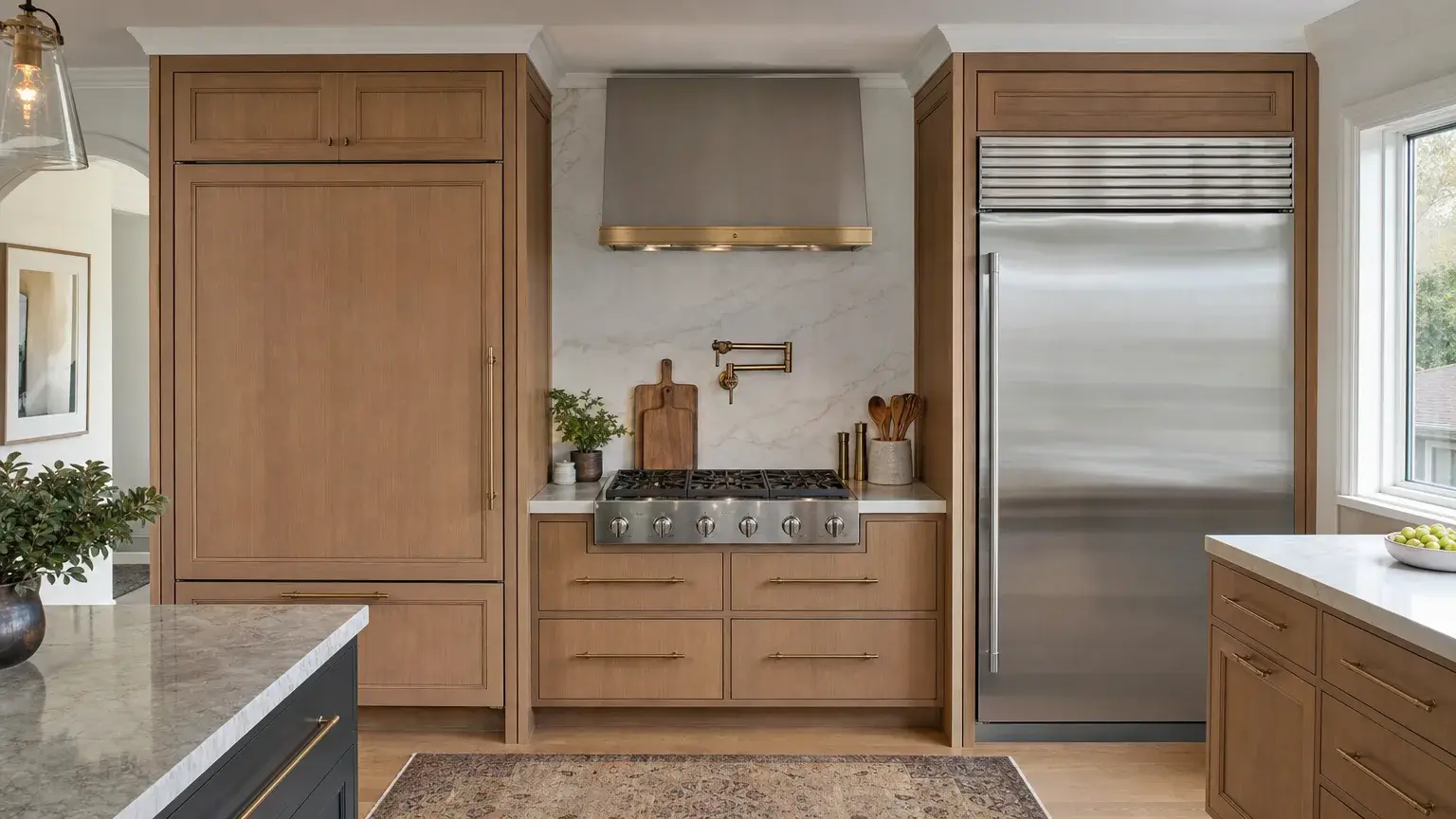
On a showroom floor, three refrigerators can look nearly identical and carry wildly different price tags. The reason usually isn’t the cooling — it’s how the unit expects to meet your cabinets. A counter-depth model is happy to stand on its own. A built-in wants a cabinet surround framing it on three sides. A panel-ready unit wants to disappear entirely behind a door that matches your kitchen. Each of those choices writes a different work order for the carpentry around the opening, and that’s the part buyers discover too late.
Here’s how the three types differ, and exactly what each one asks of the cabinetry — so you can pick the fridge that fits the kitchen you actually have.
The three types, plainly
Counter-depth (freestanding)
A counter-depth refrigerator is a normal freestanding unit with a shallower body — typically a few inches less deep than a standard fridge — so the doors sit close to flush with a standard countertop overhang. It plugs in, rolls into place, and stands alone. You’ll still see finished side panels and a gap on each side, and the doors and handles project past the cabinet faces.
Built-in
A built-in is taller, deeper-set into the wall, and engineered to be framed by cabinetry on both sides and across the top. The body recesses so the doors finish close to the cabinet face, and a custom top panel or matching cabinet closes the gap above. It is designed to look like part of the millwork, not an object parked in front of it.
Panel-ready / integrated
Panel-ready (often called integrated) takes the built-in idea one step further: the doors are bare and built to carry a custom overlay panel that matches your cabinet doors. Done right, the refrigerator reads as a tall run of cabinetry — no stainless, no visible appliance. This is the look behind most high-end kitchens, and it’s what the premium integrated refrigerator brands are built to deliver.
What each type demands of the cabinet
The deeper you go from counter-depth toward integrated, the more the cabinet stops being a backdrop and becomes part of the appliance.
- Counter-depth: a correctly sized opening with finished side panels and clearance for the doors to swing. The lightest carpentry of the three.
- Built-in: a true surround — square, plumb side panels and a top cabinet sized to the unit’s overall height plus its required air gap.
- Panel-ready: everything a built-in needs, plus a custom overlay panel cut, weighted, and hung to the manufacturer’s exact published dimensions.
Surround width and the side reveals
Built-in and panel-ready units publish a required finished opening width — the clear space between the surround panels — and it is unforgiving. Too tight and the unit won’t slide in or the doors bind; too loose and you get ugly side gaps that no trim hides cleanly. The surround panels usually need to run full height and sit dead plumb, because any lean shows up as a tapered reveal along the door edge. On a tall unit, a quarter-inch of lean at the floor becomes a very visible wedge at the top.
Depth and the wall behind
Built-in and integrated refrigerators sit deeper than they appear. The cabinet has to give up real depth, and whatever lives in that wall cavity — the water line, the receptacle, the stub for an ice maker — has to be recessed or relocated so it doesn’t hold the unit proud of the surround. A box that pushes the fridge out even half an inch ruins the flush look the whole upgrade was paying for.
Height and the top cabinet
These units are tall, and they need a specific air gap above the grille. The top cabinet (or a custom finished panel) gets built to land at the unit’s overall height plus that clearance — not pressed down onto the appliance. This is where a support platform or a furred-down soffit often comes into play, and where a half-inch error means the doors won’t clear or the grille gets choked.
Overlay panels: weight, reveals, and hinges
Panel-ready is where carpentry and appliance meet most directly. The overlay panel isn’t decorative trim — it’s a structural door face the refrigerator has to swing thousands of times.
- Size to spec, not to eye. Each model publishes a panel height, width, and thickness, plus a handle and rail location. The panel gets built to those numbers, not to whatever looks balanced.
- Mind the weight. A solid panel can be heavy, and the hinges are rated for a maximum. Overbuild the panel and the door sags, drifts open, or strains the hinge; underbuild it and it looks flimsy next to adjacent doors.
- Match the reveals. The gap around the fridge panel has to line up with the gaps between your other cabinet doors. Integrated work lives or dies on these reveals reading consistent across the whole run.
- Account for the handle. Whether you’re matching cabinet pulls or using a recessed channel changes the panel layout, so it’s decided before the panel is cut.
A panel-ready fridge is only as good as the panel and the surround around it. The appliance is half the job; the cabinetry is the other half, and they have to be planned together — not bought first and figured out later.
Ventilation, the grille, and the water line
All three types still need air and, usually, water — but the rules tighten as you go up.
- Ventilation: counter-depth units mostly breathe from the back and sides with a freestanding gap. Built-in and integrated units vent through a top (and sometimes base) grille, so the surround must leave that grille fully open and honor the specified clearance. Sealing them in tight is the most common cause of an early compressor failure.
- The grille itself: built-in and panel-ready models include or accept a grille at the top of the surround. Its height factors into the overall cabinet height, so it gets planned with the top cabinet, not added as an afterthought.
- Water line: plumbed ice and water needs a supply line and shutoff inside the cavity, positioned so it doesn’t hold the unit proud and stays reachable after install. With deeper built-in and integrated bodies, that line almost always needs to be recessed into the wall.
Choosing the right one for your kitchen
Work backward from the look you want and the space you have:
- Want the cleanest budget path and don’t mind visible sides? Counter-depth. Lightest cabinet work.
- Want the fridge to read as part of the cabinetry but keep a stainless face? Built-in. Plan a true three-sided surround.
- Want the appliance to vanish into the cabinet run entirely? Panel-ready / integrated. Plan the surround and a custom overlay panel from the start.
Whichever you lean toward, the deciding factor is rarely the fridge — it’s whether the surround, depth, reveals, and ventilation can be built to that model’s published numbers in your actual kitchen.
Before you buy
The expensive version of this project is the one where the refrigerator arrives first and the cabinets are made to chase it. The smart version runs the other way: confirm the opening, the depth, the surround, and — for panel-ready — the panel plan against the exact model’s spec sheet before you order.
So before you settle on counter-depth, built-in, or integrated, let us measure the opening and read the spec sheet alongside you. Call us with the model you’re eyeing, or request a fit check and we’ll tell you which of the three your kitchen can carry — and what the surround and panel will take to get there.