Why Appliance Delivery Crews Won't Modify Your Cabinets (and What to Do)
Delivery day isn't install day — and the crew that drops your new appliance won't touch a cabinet to make it fit, no matter how close the numbers are.
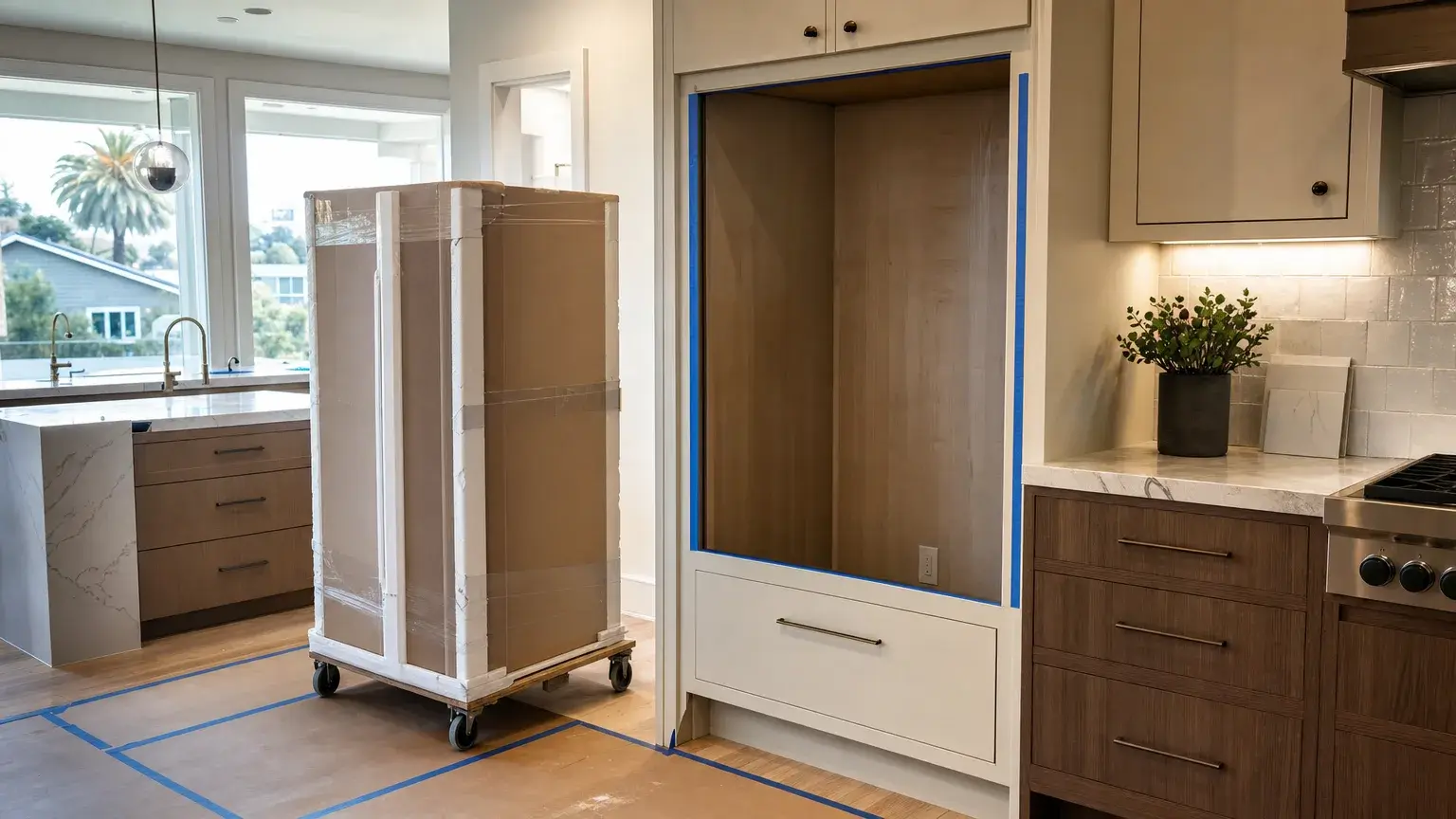
You picked the appliance, scheduled delivery, and cleared the kitchen. Two people arrive, wheel the box in on a dolly, slide it toward the opening — and it stops a half-inch short. They check the work order, shrug, and tell you the cabinet needs to be modified before they can finish. Then they leave the unit in the middle of the floor and drive to the next stop.
This is one of the most common ways a new-appliance project goes sideways, and it surprises people because the line between “delivery” and “installation” is almost never spelled out at the register. Understanding what a retail crew is actually scoped to do — and what they’re forbidden from doing — is the difference between a smooth swap and a kitchen held hostage by a boxed appliance.
Delivery and installation are two different jobs
When you buy from a big-box store or an appliance retailer, the service attached to your order usually falls into one of three buckets, and they’re rarely labeled clearly:
- Drop-off only — the crew carries the appliance to a room and leaves it. No unboxing, no hookup.
- Basic install — they set the unit in an existing opening and connect to hookups that already match (a cord to a live outlet, a hose to a working valve, a flex line to a capped gas stub).
- Haul-away — they remove your old appliance, often only after the new one is successfully placed.
Notice what’s missing from every tier: changing the opening. A basic install assumes the appliance drops into a cavity that already meets spec. The moment the cabinet fights back, the crew is outside their scope.
Why the crew won’t touch your cabinet
It isn’t laziness, and it usually isn’t that they couldn’t manage a few cuts. There are concrete reasons a delivery team is instructed to stop rather than modify.
Liability and insurance
Cutting a face frame, removing a stile, or building a platform is structural carpentry on your property. If a modified cabinet later sags, splits, or fails, the retailer is on the hook for work it never priced or warrantied. Delivery contracts draw a hard line at “as-is opening” specifically to keep that risk off the books. The crew is told, in writing, not to cross it.
Scope and time
Delivery routes are built around tight time windows — often six to ten stops a day. A clean swap takes minutes; a cabinet modification can take an hour or more and demands tools the truck doesn’t carry. Even a willing crew can’t absorb that without blowing the rest of the route, so the work order simply doesn’t allow it.
Skills and tools
Delivery and carpentry are different trades. A delivery team is excellent at moving heavy objects safely and making standard connections. Scribing a filler panel, squaring an out-of-level opening, or trimming a built-in cavity to a manufacturer’s tolerance is finish carpentry — measured, cut, and fit to fractions of an inch. It’s not on a dolly crew’s toolkit or training.
The retailer’s “installer” is scoped to connect an appliance, not to make a cabinet ready for one. Those are separate skill sets, and the cheaper service almost always means the first.
What the homeowner is left holding
When a delivery fails on a fit issue, the fallout lands entirely on you, and it tends to compound:
- A boxed appliance in the middle of the floor, sometimes for days, while you sort out next steps.
- No old appliance, if haul-away already happened or the old unit was disconnected to test the fit.
- A return or restocking clock ticking on the new unit, with fees if you miss the window.
- A second delivery fee to bring the crew back once the opening is fixed.
- Scramble pricing for whoever you call last-minute to modify the cabinet under time pressure.
The single appliance you wanted has now turned into three separate problems — storage, scheduling, and carpentry — none of which the delivery crew is going to solve.
The mismatch that causes most failed deliveries
Almost every failed fit traces back to one assumption: that the old appliance’s footprint equals the new one’s required opening. It rarely does.
- The old unit may have been forced, shimmed, or undersized to begin with, so the cavity was never truly to spec.
- Manufacturers publish a cutout or rough-opening dimension that differs from the appliance’s own body size — and it varies by brand and model.
- Counter-depth and built-in units need clearances for doors, handles, and panels that a freestanding predecessor never required.
- Older kitchens drift: floors go out of level, face frames bow, and a glued-in filler quietly steals a quarter-inch.
Any one of these can leave you a fraction short, and a fraction is all it takes for a delivery crew to call it and leave.
How to avoid the failed-delivery trap
The fix isn’t complicated, but it has to happen before the truck is scheduled, not after.
Check fit against the spec, not the old unit
Pull the installation manual for the exact model — not the marketing page — and find the required cutout dimensions. Compare those numbers to your actual opening measured at its tightest point. If you’re not sure how, our guide to measuring a cabinet opening walks through width, height, depth, and the clearances spec sheets assume.
Read the delivery terms before you buy
Ask the retailer two plain questions and get the answers in writing:
- Does the install service include any modification to the opening? (The answer is almost always no.)
- When does haul-away happen — before or after a successful install?
Knowing this up front means a tight opening becomes a planning detail instead of a driveway emergency.
Line up an installer who also does the carpentry
The cleanest path is a single crew that installs the appliance and modifies the cabinet in the same visit — resizing or squaring the opening, building a support platform, scribing fillers, and aligning overlay panels as needed. One trip, one accountable party, and no gap between “it doesn’t fit” and “it’s running.” This matters even more for panel-ready and built-in models, where the panel and trim work is part of the install, not an afterthought.
Close the gap before the truck shows up
A boxed appliance stranded on your floor is the expensive version of a question you could have answered in advance. The delivery crew will never bridge the gap between “it doesn’t fit” and “it’s running” — that gap is yours to close, and the smart time to close it is before a delivery date is on the calendar.
So get the opening measured against the model’s actual cutout spec, confirm the haul-away timing in writing, and if the cabinet needs trimming, a platform, or panel work, schedule one crew to handle the carpentry and the hookup in a single visit. Call us to line up the install and the cabinet work together, and the retailer’s truck has nothing left to walk away from.